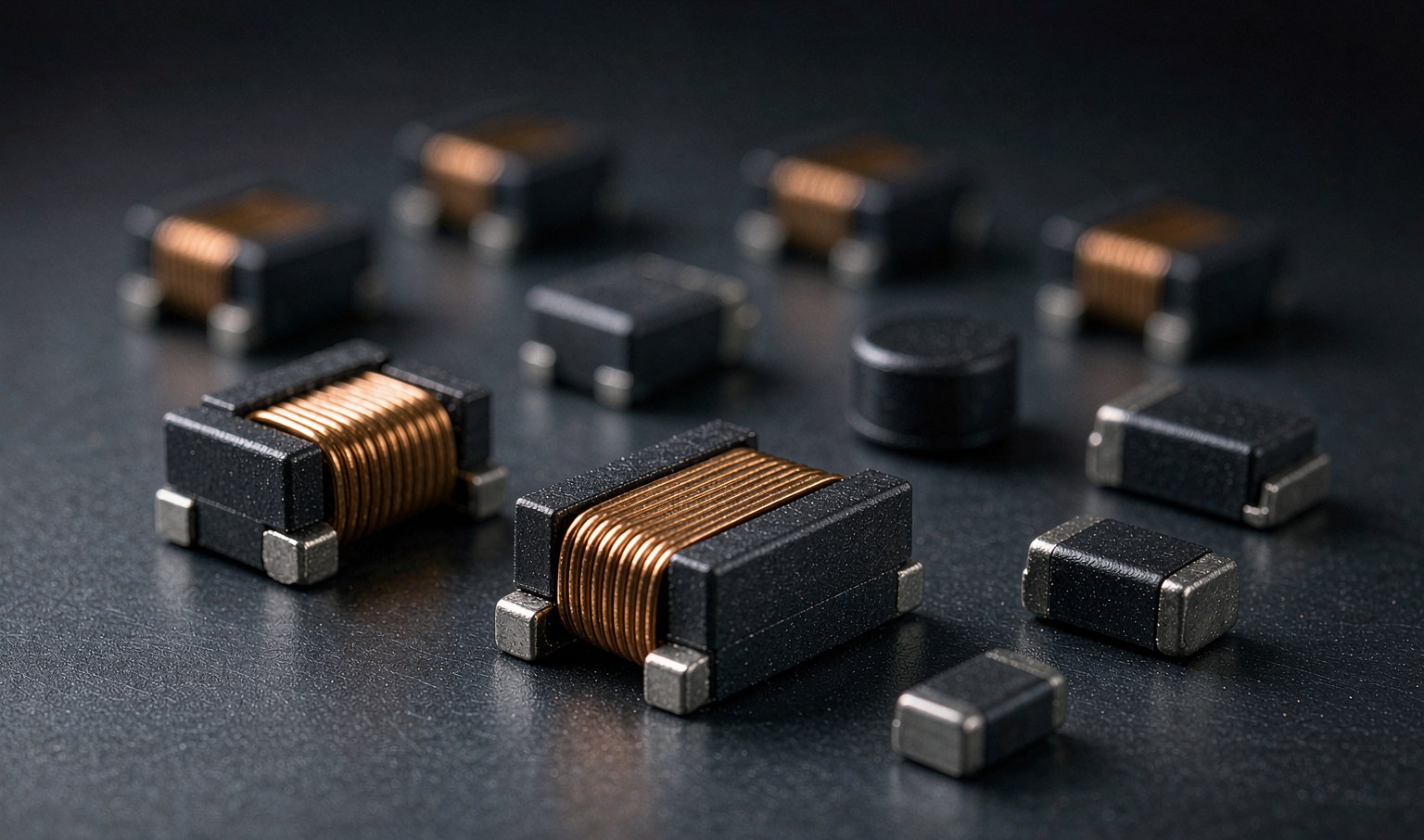
Four process platforms — molded, multilayer, magnetic glue and wire-wound common mode — covering 0402 to 1210. Low DCR, low buzz, high saturation: the same key to DC-DC and EMI.
From magnetic powder formulation, winding tension and pressing density to terminal plating — every step decides two things: whether temperature rise stays down, and whether noise stays in.
KRN runs its inductor lines under a semiconductor-grade quality system: traceable incoming material, comparable lots, measured data with every shipment. On the same datasheet, we care more about the lower limit.
Pick a brand, then type a part number or prefix (e.g. WE-PMCI, TFM2520, IHLP-1616). The handbook covers 190+ KRN part numbers and 600+ cross-references.
Cross-references are taken from the KRN power inductor handbook. For reference only — verify size, inductance, DCR and saturation current against both datasheets.
Storage: molded. Filtering: multilayer. Noise: bead. Differential lines: common mode. Decide the purpose first, then size and current.
Metal powder molded body: shielded, low DCR, high saturation current. First choice for DC-DC storage.
Ceramic multilayer, small and consistent — for high-frequency, low-current filtering.
Thicker electrodes and low-resistance paste, for fast-charging paths.
Shielded wire-wound: low leakage flux, low buzz, friendly to nearby sensitive circuits.
Cost-optimized, wide inductance range, for supplies insensitive to size and leakage.
Glue-coated winding: interference and noise control combined, common in LED drivers.
High-frequency impedance with low DCR — EMI absorption on supply and signal lines.
Large electrodes, low resistance, high current for supply paths.
Symmetrical bifilar winding for USB, CAN, audio and differential signals.
Typical coverage per series; available ratings follow the latest selection guide. 31 inductor part numbers are already listed in the product center.
Lock two of the three — size, inductance, current — and the third is basically decided. Then confirm temperature rise and saturation with measured curves.
| Series | Process | Size (imperial) | L / Z | Typical current | Main use |
|---|---|---|---|---|---|
| Molded | Metal powder molded | 0420 – 1265 | 0.22 – 47 µH | 1 – 20 A | DC-DC storage |
| Multilayer | Ceramic multilayer | 0402 – 0805 | 0.047 – 47 µH | 50 – 800 mA | High-frequency filtering |
| High-current ML | Thick-electrode multilayer | 0805 – 1206 | 0.1 – 4.7 µH | 1 – 3 A | Fast-charging path |
| Shielded | Shielded wire-wound | 0402 – 1210 | 0.1 – 1000 µH | 0.1 – 5 A | Low-leakage supplies |
| Unshielded | Wire-wound | 0402 – 1210 | 0.1 – 470 µH | 0.1 – 3 A | General supplies |
| Magnetic glue | Glue-coated | 0402 – 1210 | 0.1 – 100 µH | 0.3 – 3 A | LED drivers |
| Bead | Multilayer bead | 0201 – 1206 | 10 – 2000 Ω | 0.5 – 6 A | EMI suppression |
| High-current bead | Large-electrode bead | 0805 – 1210 | 30 – 600 Ω | 2 – 8 A | Supply path noise |
| Common mode | Symmetrical winding | 0805 – 1210 | 90 – 2000 Ω | 0.1 – 1 A | Differential filtering |
Series-level coverage, not a single part. Full part list with tolerance, DCR, Isat and Irms is available on request.
Inductor failures rarely show up on the datasheet: a loose winding, a slightly lower density, a thinner plating — and it becomes a complaint three months into mass production.
Particle distribution and insulation coating set saturation and loss; incoming material is kept per lot for comparison.
Uniformity is what matters in molded parts; density gaps cause local heating and buzz — checked by X-ray and cross-section per lot.
Three-layer electrodes with controlled thickness, verified by solderability and solder-heat resistance tests.
L, DCR and dielectric withstanding voltage sampled before shipment; samples retained for two years.
Storage, filtering, noise suppression or signal isolation? Lock the function first.
Board area and placement capability decide 0402 / 0603 / 0805 / 1210.
Work back from peak current and allowed temperature rise to Isat / Irms, with 20% margin.
Request samples; we provide L-vs-current curves and temperature rise data.
Have an inductor to replace? Send the part number, we return a comparison and the risk points.
Special inductance, size or plating — custom development and dedicated lines are possible.
Specifications argued a hundred times are worth less than one bench test. Tell us size and current, samples and selection guide ship together.